

FWM Docks Resource Center
EZ Dock Buyer’s Guide for Northeast Waterfronts
Compare layouts, sections, PWC ports, kayak launches, anchoring, colors, maintenance, and installed cost before you design your dock. From the team that has installed thousands of EZ Dock systems on almost every body of water in the Northeast.
Since 1975
Family-owned dock builder
Since 2005
Exclusive EZ Dock distributor, NE
Thousands
Of dock systems installed in NE
Leading
Aluminum dock manufacturer in NE
Last updated May 2026 · Reviewed by FWM Docks Design & Installation Team
If you have started shopping for a dock, you have probably already typed “EZ Dock” into Google a few times. It is one of the most widely installed modular floating dock systems in the Northeast, and there is a reason for that: when the ice goes out in March and your neighbors are still scraping mud off splintered stringers, the right EZ Dock setup is back in service quickly. With a winterization plan worked out in advance — every site is different — owners are walking onto a clean, level deck and stepping into the boat.
This is the guide we wish every customer read before they called us. It covers what EZ Dock actually is, when it is the right choice, how to size and lay out a system, what it costs in 2026 dollars, and the questions we hear most often from waterfront homeowners, marinas, camps, and municipalities from Lake George to the Cape.
FWM has manufactured aluminum dock systems since 1975 and has been the exclusive EZ Dock distributor for the Northeast since 2005. We sell both because we believe both are the right answer for different waterfronts. This guide focuses on EZ Dock, the modular polyethylene system, because it is the right fit for most residential floating-dock, PWC, kayak, swim, and accessible-launch projects we see. We have installed thousands of EZ Dock systems across nearly every type of Northeast shoreline, from inland lakes to tidal and coastal sites, which means we have seen every layout, every condition, and every regret. What follows is the field-tested version.
What EZ Dock actually is
EZ Dock is a modular floating dock system built from rotationally molded linear low-density polyethylene (LLDPE). Each section is a one-piece, foam-free module with an integrated pylon chamber design that provides flotation, structure, and the textured walking surface in a single rotomolded shell. There are no wood deck boards to rot, no foam drums to waterlog, and no traditional deck fasteners holding the walking surface together. Sections lock together with the EZ Dock coupler system, which lets the dock flex with waves and chop instead of fighting them.
Standard sections come in three widths, so you can match the system to how you actually use the water:
40-inch section
2,000 lbs
distributed live load capacity
Section weight: 167 lbs. Best fit for kayak launches, swim platforms, and tight residential layouts where weight and footprint matter.
60-inch section · most popular
3,000 lbs
distributed live load capacity
Section weight: 257 lbs. Our most-installed residential section. Right balance of platform size, weight per coupler, and load capacity.
80-inch section
4,000 lbs
distributed live load capacity
Section weight: 338 lbs. Wider walking surface, ideal for entertainment platforms, marina face docks, and ADA-accessible designs.
Capacities and weights reference current EZ Dock published specifications. The system is engineered for 77 mph sustained wind, 1-foot continuous and 3-foot occasional wave action, a -130°F cold-brittleness threshold, and 62.5 lb/ft² live load per EZ Dock spec. Field performance varies with anchoring, water conditions, and how the load is distributed.
Beyond those three core sizes, EZ Dock also makes specialty pieces — 80″ × 100″ wide platforms, narrow 20″ × 5′ and 20″ × 10′ sections, 60″ × 60″ half-hexagons, Tri Docks for branching layouts, and corner gussets for non-standard angles. The core system we recommend is built around the 40″, 60″, and 80″ widths, and that is what about 90% of our Northeast installs use. The full sizing catalog lives at ez-dock.com.
Color options ship in two finishes: a warm Beige and a cool Gray. Both are UV-stabilized through the full thickness of the polyethylene, so a scratch from a dropped anchor does not expose a different color underneath. Because the color runs through the material, the deck does not require staining or refinishing the way wood and composite systems do.
EZ Dock vs. wood, aluminum, and the rest
FWM manufactures aluminum dock systems and distributes EZ Dock, so we sell both sides of this comparison. We are not pretending to be neutral, but we have no incentive to push you toward one or the other if it is wrong for your shoreline. This is how the trade-offs actually shake out after a decade in the water.
| Attribute | EZ Dock (LLDPE) | FWM aluminum dock | Pressure-treated wood |
|---|---|---|---|
| Service life | 30+ year field service life with proper anchoring and care | Aluminum frame built to last a lifetime; maintenance-free decking engineered for decades of use | Often shorter, especially with ice, salt, or neglected maintenance |
| Maintenance | Annual rinse, periodic coupler check | Maintenance-free decking from ThruFlow up to ultra-premium surfaces — no staining, sealing, or board swaps | Annual seal, board replacement, hardware |
| Ice tolerance | Engineered for cold; leave-in is site-specific and requires a winterization plan with FWM | Removable systems handle it; fixed frames suffer | Frost heave and ice movement crack stringers |
| Wave/wake feel | Flexes with chop, gentler underfoot | Stiff, planted feel underfoot — minimal flex | Stiff, depends on framing |
| Reconfiguration | Modular, add or move sections in hours | Custom layouts built to spec; reconfigs need hardware work | Rebuild required for layout changes |
| Up-front cost | Mid to high | Mid to high | Lowest |
| 10-year total cost | Lowest of the three | Low — no refinish or board replacement costs | Highest once rebuilds are counted |
Wood docks are the cheapest to put in and the most expensive to own. We don’t rebuild wood docks — we are constantly replacing them with our products, which is part of why we built our EZ Dock business in the first place. Aluminum-frame floating docks are a step up on durability and a step down on flex; FWM’s aluminum systems are excellent for marinas, commercial face docks, and saltwater applications where structural rigidity matters more than chop absorption. EZ Dock trades a higher up-front cost for almost no maintenance, modular flexibility, and a 30-year-plus service life. We still service docks from the 1990s and early 2000s — many of those original sections are still in the water alongside the new ones we install for the same customers, and they still look great. The math works if you plan to own the property for more than five or six years.
If you are choosing between brands of floating dock — EZ Dock, Candock, Wave Armor, Dock Blocks — that is a longer conversation, and we will have it with you honestly. Three things separate EZ Dock from the rest.
The coupler. The coupler system is the engineering keystone of the EZ Dock platform. It locks sections together with controlled flex — the dock rides with waves and ice instead of fighting them — and lets us reconfigure a layout in hours instead of a full rebuild. Most competitors use rigid bolt-through hardware that transmits every wake to the walking surface and tends to fail first when conditions get rough. Ask any competitor for their coupler spec sheet alongside EZ Dock’s and look at the tested pullout strength and serviceability side by side. The difference is the system, not the marketing.
Corporate backing and dealer network. EZ Dock has the deepest dealer footprint in North America and stands behind a 10-year limited manufacturer warranty on flotation products. You are buying a dock once every twenty or thirty years — you want the company that made it and the dealer who installed it to both still be standing in 2040 when something needs attention. EZ Dock has the corporate backing and the regional density to be there for the long haul. Most of the others do not.
Field track record and accessory depth. We have installed all of these brands at one point or another — Candock, Wave Armor, Dock Blocks, the rest — and we have come back to repair or replace most of them. EZ Dock has the most accessory options in the category (PWC ports, kayak launches, swim ladders, ADA-accessible launches, BoatPorts) and the longest field track record. It is the only modular floating dock we still sell, because it is the only one we have not regretted putting on someone’s lake.
One thing we tell every shopper before they sign anything: ask the dealer for the manufacturer’s full product spec sheet — section weight, load capacity, wall thickness, coupler pullout strength, cold-brittleness rating, UV inhibitor data, warranty terms. We will hand you ours. If a competitor will not, or cannot, that tells you something quiet but important. We chose EZ Dock for our own families’ docks, which is the only reason we sell it.
Configurations: shapes that work on real shorelines
EZ Dock is a system, not a kit. You build the dock around your shoreline and how you actually use the water — not the other way around. The four below are popular configurations we install across the Northeast — your shoreline, water depth, boat, and use will decide which one fits your site.
Layout 01
Straight run
Sections coupled end-to-end out from a fixed shore connection. Best for narrow lots, deep water close to shore, or single-direction wind exposure. Typical: 4-6 sections plus a gangway.
Layout 02 · most common
L-configuration
A straight run with a perpendicular section at the end. Boat tie-up on the outside leg, sheltered swim or kayak side on the inside. Our most-installed residential layout in protected coves and lakes.
Layout 03
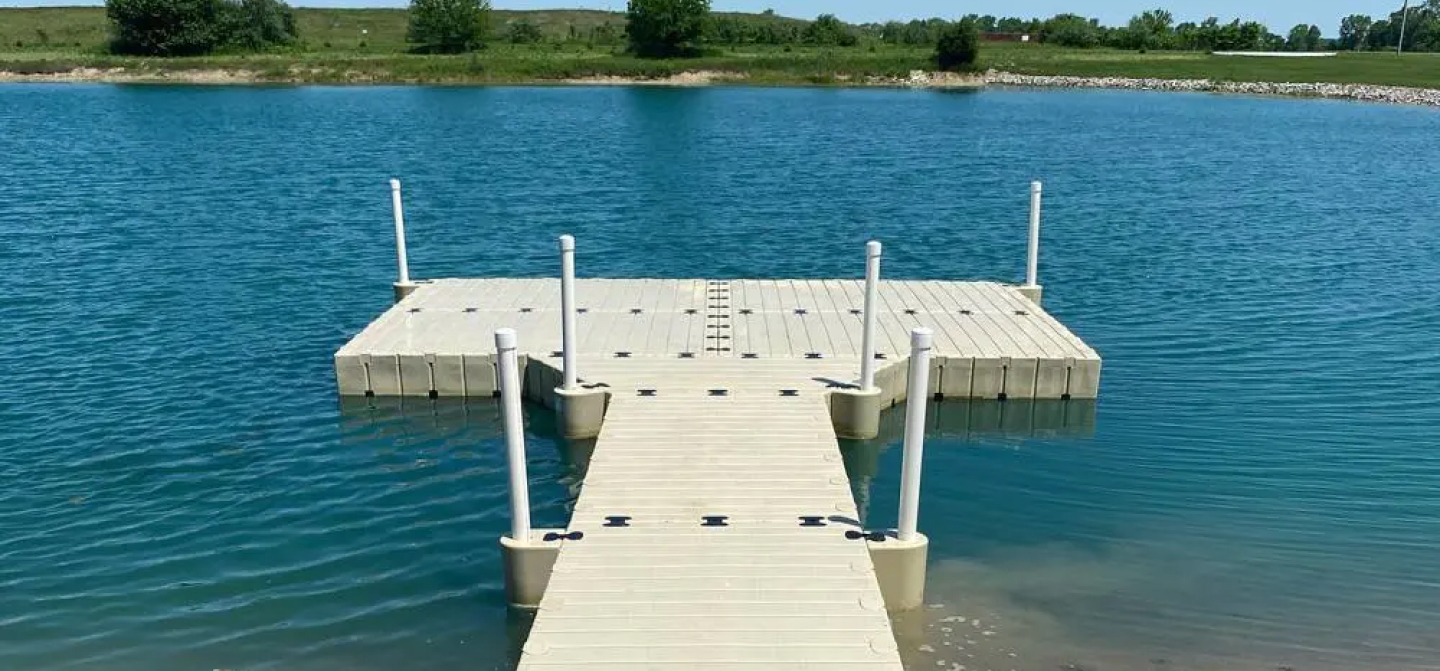
T-configuration
Straight run with a perpendicular section centered at the end. Two-boat tie-up — one on each side of the T — or a wider entertaining platform. Recommended when you actually need two boat slips.
Layout 04 · serious setup
U-configuration with slip
Walking dock with a covered slip area, often paired with a BoatPort or boat lift. For owners who keep a 22-foot boat in the water all season. Add a kayak launch off the inside leg for a complete waterfront.
The system is modular by design. We have reconfigured customer docks five years after install when their boat changed, when a kid took up paddle boarding, or when they bought a jet ski. Adding a section costs the price of the section plus a few hours of labor, not a full rebuild.
Sizing: how much dock do you actually need?
The single biggest mistake we see homeowners make is buying too small. A dock that fits your current boat with no margin will not fit the boat you will own in five years, and it will not accommodate the inevitable kayak, paddle board, swim ladder, and grandkids that arrive with it. Plan for the next decade, not last summer.
Rough rule of thumb for residential use: pick the boat you might own in five years, add 4 feet of dock for each side you want to tie against, then add another 12-16 feet for the walking run from shore. A 20-foot bowrider with a single tie-up side wants a 12-foot face plus a 16-foot run — about 5-6 EZ Dock sections plus a gangway. Add a PWC port off the side and you are at 7-8 sections.
Water depth matters more than dock length. EZ Dock floats, so it adapts to changing water levels — but you still need enough water at your tie-up face for the boat at its lowest summer pool. We aim for 3.5 to 4 feet minimum at the dock face for an average runabout, more for cruisers and pontoons with deeper drives, If you are not sure, send us a photo and water depth at the planned tie-up location and we will size it for you.
Not sure where to start? Use our Dock Finder or send us a few photos of your shoreline and we will sketch a configuration with a section count and a planning range, usually within a few business days.
Color: Beige or Gray
EZ Dock ships in two stocked colors in the Northeast — Beige and Gray. Most of our installs run about 80% Gray to 20% Beige. Gray has clearly overtaken Beige as the more popular choice in the last few years. Both are through-color LLDPE, so they do not fade dramatically and do not need refinishing.
Beige
The warm choice
Reads as a soft tan. Blends into sandy or rocky shorelines. Hides bird droppings and dirt better than the gray. Recommended for properties with light siding, cedar shake homes, or any setting where the dock should disappear into the landscape.
Gray · most popular
The modern choice
Reads as a medium driftwood tone. Contrasts cleanly against blue water. Pairs well with darker home exteriors and aluminum boats. Both Beige and Gray are lighter than typical dark decking, which helps keep the surface more comfortable in direct sun.
For larger commercial and municipal projects, EZ Dock can custom-mold sections to a specific color. FWM did exactly that for the mile-long rail system at Lake Williams in Marlborough, MA, where the spec called for a dark brown to blend with the surrounding landscape — proof that the standard Beige and Gray are starting points, not the only options when the project warrants it.
You can mix colors within a single dock — we do it occasionally for marinas that want to mark guest slips visually — but for residential we recommend picking one and committing. Mixed-color residential docks tend to look unintentional rather than designed.
Anchoring: the part nobody thinks about
How you tie your dock to the bottom is more important than which dock you buy. A perfectly engineered EZ Dock with bad anchoring will move, twist, and frustrate you. A correctly anchored dock will sit exactly where you put it for decades.
Which anchoring method fits your site?
Three quick questions, one starting recommendation. We confirm and engineer the actual anchoring on a site visit.
Water depth at the dock face?
Water movement at your site?
Winter ice exposure?
Pile anchoring
Get a site quote →Method 01 · gold standard
Pile anchoring
Vertical pipes set in the bottom with sleeves that let the dock rise and fall with water levels. Three variations: steel or wood pile for permanent sites, galvanized pipe with auger anchors for most seasonal residential installs. Best for protected coves under 15 feet to bottom. Ice tolerance is site-specific and requires a winterization plan with an FWM dock specialist.
Method 02
Stiff-arm to shore
Rigid arms connecting the dock to a fixed point on land — typically a concrete deadman or a shoreline footing. Best for sheltered locations with stable water levels, like ponds and small lakes. Cheaper than piles but does not handle big water-level swings as gracefully.
Method 03 · deep water
Chain or cable
Weights or auger anchors on the bottom with chain or cable to the dock. Required for deep water (over about 15 feet) and rivers with current. Bulletproof when the geometry is right; we do not recommend it as a DIY project.
In the Northeast, leave-in is never one-size-fits-all. We review winter exposure, anchoring, and risk on every site, and an FWM dock specialist works through a winterization plan with you before we recommend an approach. Some sites get piles with a documented ice-management plan; others get a removable system that comes out before freeze-up. Moving ice creates damage that is rarely worth the risk, and the decision belongs in a conversation, not a brochure.
Maintenance: what 30 years of ownership looks like
The pitch is “no maintenance.” The reality is closer to “almost no maintenance.” Here is the honest 30-year timeline for an EZ Dock system installed in the Northeast.
Annual
Pressure-wash the deck once each spring. A garden hose handles algae and pollen; a pressure washer on a low setting handles waterline scum. About an hour for a typical residential dock.
3-5 yrs
Inspect couplers and tighten any that have backed off. Quarter-inch socket, fifteen minutes for a typical dock. Replace any cleats showing wear from heavy use.
10-20 yrs
If your dock is on piles, inspect for ovality and replace any that have worn. Check the rubber couplers for wear and replace any that have lost grip. Service life depends on water and ice exposure. The only meaningful recurring cost on the system.
Never
Re-staining, re-decking, replacing rotten boards, or replacing rusted fasteners. None of these are part of EZ Dock ownership.
What it costs in 2026
Plain numbers, no spin. The ranges below are derived from FWM closed-won EZ Dock installs in the Northeast — what real customers actually paid, not list-price guesswork. Final pricing depends on layout, anchoring, water access, depth, freight, permitting, labor, and season, and we provide a fixed-price installed quote after a site visit.
Estimate your EZ Dock planning range
Adjust the inputs and watch the range update. This is a planning tool from public dealer ranges, not a quote. Use it to set expectations before you call us.
| Project type | Installed planning range | Materials only (DIY) |
|---|---|---|
Small additions 1-2 sections, port, kayak launch, or accessory swap | $1,500 – $5,000 | $1,000 – $3,500 |
Small residential dock 3-5 sections + gangway + standard hardware | $5,000 – $10,000 | $3,500 – $7,000 |
Mid-sized L with PWC port 6-8 sections, gangway, piles or stiff-arm hardware | $9,000 – $18,000 | $6,500 – $13,000 |
Larger T or U with slip 10-14 sections, full anchoring, kayak launch, lift mounts | $18,000 – $35,000 | $13,000 – $25,000 |
Commercial / municipal Marinas, public launches, ADA-accessible installations | $50,000 – $200,000+ | $35,000 – $140,000 |
Planning ranges derived from FWM closed-won EZ Dock installs. Final pricing is determined on a site visit and quoted in writing.
Accessories: what is worth adding
EZ Dock’s accessory line is the deepest in the floating-dock world. After installing thousands of systems, here is what we actually recommend versus what is just upsell.
Worth it for almost everyone. Cleats (more than you think — six per residential dock minimum), bumpers along any tie-up face, a swim ladder if you have water deep enough to swim, and a gangway with handrails for any drop over about 18 inches. Browse EZ Dock accessories for the full catalog.
Worth it if you will use it. PWC ports save your jet ski from a beating and your hands from launching it. Kayak launches make solo paddling possible for kids, older paddlers, and anyone with a bad back. BoatPort drive-on units protect a serious boat investment and pay for themselves in hull life on saltwater. Solar dock lighting is a fast-growing category for us — clean, low-maintenance light that does not need a shore-power run, and most owners are glad they added it the first time they walk the dock at dusk.
Skip unless you have a specific need. Branded merchandise and the more elaborate furniture options can usually wait. Spend the money on the right layout and access first; add comfort accessories once the core dock is right.
FWM online store
Most accessories ship in 1 business day
The FWM web store carries the full EZ Dock catalog — sections, ports, kayak launches, cleats, bumpers, gangways, hardware, and replacement parts. Most orders ship from our Northeast warehouse in 1 business day, so DIY add-ons land on your driveway when you actually need them.
Real Northeast installs
A small sample of the work, anonymized to protect customer locations. Photos and full case studies are available on request.
Residential · NH
Lake Winnipesaukee, New Hampshire
L-configuration EZ Dock with PWC port and swim-side kayak launch on pile anchoring. Designed with a seasonal removal plan; FWM handles spring reinstall and is back in the water by Memorial Day each year.
Municipal · MA
Lake Williams Trail · Marlborough, Massachusetts
Mile-long public rail system in custom dark-brown EZ Dock molded specifically for the project to blend with the trail and shoreline. Town-managed seasonal staging with ADA-compliant transitions and daily community use.
Commercial · RI
Breezy Point Marina · Warwick, Rhode Island
Marina rebuild mixing FWM aluminum face docks for slip and guide-boat tie-ups with EZ Dock modular sections for guest launches and PWC ports. Designed for tidal and coastal exposure with full seasonal service.
Frequently asked questions
How long does an EZ Dock last?
EZ Dock flotation products carry a 10-year limited manufacturer warranty. In the field, we regularly see properly installed sections remain in service well past the warranty period — we still service docks from the 1990s and early 2000s — installing new sections and accessories alongside the originals, and the older sections still look great — when anchoring, hardware, and ice exposure are managed correctly. Piles and hardware are shorter-lived than the polyethylene itself, typically 10-20 years depending on water and ice conditions.
Do I have to take it out for winter?
It depends on the site, and there is no blanket answer. Whether an EZ Dock can stay in the water through winter is site-specific and always requires a winterization plan worked out with an FWM dock specialist before the first season. On the right lake with the right anchoring and ice-management approach, leave-in is sometimes the right call. On rivers with moving ice, tidal locations with heavy ice movement, exposed water, or any site without a documented winterization plan, removal is the safer choice — and we offer winter removal and spring reinstallation as a service. Either way, an FWM dock specialist walks through the conditions, anchoring, and risk with you before we recommend an approach.
Can I install EZ Dock myself?
Yes, with caveats. The sections themselves are lightweight enough for two people to handle, and the coupler system is straightforward. Where DIY installs go wrong is anchoring — pile driving, deadman placement, and chain geometry are not intuitive and the consequences of getting them wrong are expensive. We sell direct to DIYers and ship to your driveway. We also do install-only contracts where we set the anchoring and you handle the assembly. Talk to us before you start.
Are EZ Docks slippery when wet?
Less than most dock surfaces, and that is one of the questions we hear most from shoppers with kids, dogs, or older paddlers. The deck is molded with a textured ‘orange peel’ finish and shallow drainage troughs, and it tests at a coefficient of friction of 0.35 dry and 0.61 wet under ASTM D2394 — meaning roughly 37% more grip when wet than when dry. That is the opposite of how wood, painted decking, and most composites behave; those tend to get slicker when they get wet. EZ Dock’s deck is not a non-slip rubber mat, and we still recommend cleats, edge bumpers, and a swim ladder wherever someone is stepping off the dock into the water. For everyday walking, the surface is meaningfully more confident underfoot than the alternatives.
How much does it cost to install?
Installed cost is really driven by how many crew-hours we spend on your site — every project is scoped by the labor and equipment it actually requires. From FWM closed-won data: most residential EZ Dock installs run $5,000 to $20,000 installed depending on size, anchoring, and accessories. Larger T or U layouts with PWC ports, kayak launches, or BoatPorts run $18,000 to $35,000. Commercial and municipal projects run $50,000 to $200,000+ and are always quoted by project. We have been installing EZ Dock across the Northeast since 2005, so we are very good at walking a shoreline, reading water depth and access, and pricing the install hours accurately. The number we put on the quote is the number you pay.
What is the lead time?
Most EZ Dock sections, accessories, and replacement parts are stocked at our Northeast warehouse and ready for same-day to 1-2 week pickup or shipping. Installation lead time depends on the time of year and our crew schedule — spring and early summer fill up fastest. Our crews work hard to keep lead times as short and efficient as possible. Call us with your timeline and we will give you the soonest realistic install date for your site.
Do you service what you sell?
Yes. Every customer we install for goes onto our service list. We offer spring opening, fall closing, repair work, and reconfiguration. Most annual maintenance customers spend $300 to $800 a year that includes inspection, cleaning, and minor adjustments. Major work — pile replacement, full reconfiguration — is quoted separately.
Three ways to move forward
Ready to design your dock?
Whether you want a quote, a configuration sketch, or a real conversation about your shoreline, we are here. Family-owned since 1975 and we still answer the phone.
FWM Docks & EZ Dock Northeast — manufacturing aluminum dock systems since 1975, exclusive Northeast EZ Dock distributor since 2005, serving residential, marina, camp, municipal, and commercial waterfronts from Maine to New Jersey.